


Il est relativement récent que nous soyons parvenus à une compréhension complète. probablement proche de la réalité. de la structure de l’Univers. à la fois à grande échelle et à l’échelle subatomique. Fait remarquable. la compréhension de la structure à grande échelle (et de la manière dont elle émerge) dépend de façon cruciale de l’échelle subatomique. L’émergence et le réductionnisme vont de pair pour comprendre notre Univers.
Emergence of the Structure of the Universe
Marcaide, Jon (1); Salvador, Eduard (2)
- Filiation:
- (1) Jakiunde, Zientzia, Arte eta Letren Akademia. Prim, 7. 20006 Donostia-San Sebastián (2) Universidat de Barcelona. Physics Faculty. Martí I Franquès, 1. 08028 Barcelona
- Année de publication:
- 2025
- Lieu de publication:
- Donostia
- Traits:
- BIBLID [0212-7016; eISSN: 2953-4180 (2025), 70, 2]. - Recep.: 22-05-2025; Acep.: 24-12-2025
- DOI:
- doi.org/10.61879/riev702zkia202505
- ISSN:
- ISSN: 0212-7016; eISSN: 2953-4180

Inscrivez-vous et télécharger Publications de Eusko Ikaskuntza
Je suis déjà inscrit. Accès
1. Introduction
Human logic is adapted to the macroscopic material world perceived by our senses. This logic led us to believe, since classical times, that matter could be broken down into an indivisible unit called atom. However, at the beginning of the 20th century, it was discovered that the atom was composed of a cloud of electrons in the form of a shell and a nucleus. The nucleus, depending on the atom, in turn contained different numbers of protons and neutrons, collectively called nucleons. This way the different chemical elements and their isotopes were explained. That simple picture of matter was soon shattered when it became clear that colliding nuclei with each other at high speeds revealed more and more subatomic particles. Moreover, the number of known interactions between material particles also increased. In addition to the electromagnetic force between the negatively charged electrons of the atomic shell and the positively charged protons of the nucleus (neutrons have no charge), two other forces emerged: the strong nuclear force, which keeps protons and neutrons bound, overcoming the electromagnetic repulsion between protons through their constant exchange of pions with neutrons, and the weak nuclear force, which tends to break down the nucleus through what is known as beta decay, transforming the neutron into a proton while emitting an electron and an antineutrino. This makes isotopes with a higher number of neutrons than protons radioactive.
The study of this surprising microcosm gave rise to quantum physics. This new branch of physics does indeed accurately describe the laws that govern the microcosm, but, because it eludes our senses, it remains somewhat incomprehensible to us. That is, we know how this physics works, but it doesn't make sense to us. For example, all physical quantities, except space and time, appear quantized, and these quanta behave, according to experiments, like particles (e.g., the quantum of electromagnetic energy is identified with a photon) or like probability density waves. Another elusive aspect is that we cannot simultaneously measure certain pairs of physical quantities (called conjugates, such as the velocity and position of a particle or its energy and the instant at which it occurs). This impossibility is reflected in Heisenberg's Uncertainty Principle. We will return to this principle later.
Thus, in scientific inquiry, atoms decomposed into a myriad of smaller bodies, and forces multiplied, with no end in sight to this process. Fortunately, a new order soon began to flourish in this seemingly decaying microcosm. On the one hand, it was understood that all these subatomic particles are made up of more basic or elementary particles called quarks, of two large, opposing types, which form what is known as matter (properly speaking) and antimatter, respectively. The latter is extremely rare in the Universe today. It only appears fleetingly in particle collisions at very high energies. After their appearance, antimatter particles rapidly annihilate with their much more abundant matter counterparts. In turn, quarks and antiquarks are classified into three large families—called colors—with two different types of quarks each (up-down, charm-strange, and top-bottom). That is, there are six types of quarks and antiquarks that, in nature, are always found in pairs or triplets, never isolated. It is precisely these groups of quarks that we identify as massive subatomic particles and antiparticles or baryons: hadrons, with three quarks, and mesons, with two.
But there is more to it. Alongside quarks, there are other, lighter fundamental particles, called leptons, which in contrast exist in isolation or freely. Like quarks, leptons can also be made of matter or antimatter and also form three families or generations. One of these is composed of electrons and associated neutrinos (and positrons and antineutrinos in the antimatter version); the other two families are formed by the mu particle, or muon, and the tau particle with their respective neutrinos (and corresponding antiparticles). This classification of subatomic particles is not accidental. It responds to a set of symmetries and conserved quantities that occur in all their interactions. These interactions are, in turn, mediated by other particles that carry the three forces mentioned above. The most famous mediating particles of this type are photons, carriers of the electromagnetic force between charged bodies. Other relatively famous interactions are gluons, carriers of the strong nuclear force between quarks of different colors, which keeps them bound together within baryons.
As our reductionist approach to nature advanced, these three basic interactions have also been conceptually simplified: they only manifest themselves as distinct at low energies. At very high energies, they behave in a simpler or more unified way: the electromagnetic and weak nuclear forces merge into the electroweak force, and at even higher energies, this electroweak force in turn merges with the strong nuclear force. So far, it has not been possible to unify this latter resultant force with gravity. For this to be possible, we would need to be able to describe the gravitational force quantumly, which would entail seeing that space and time at high energies are also quantized like energy or velocity. This endeavor has occupied the best minds of theoretical physics for decades, without success so far.
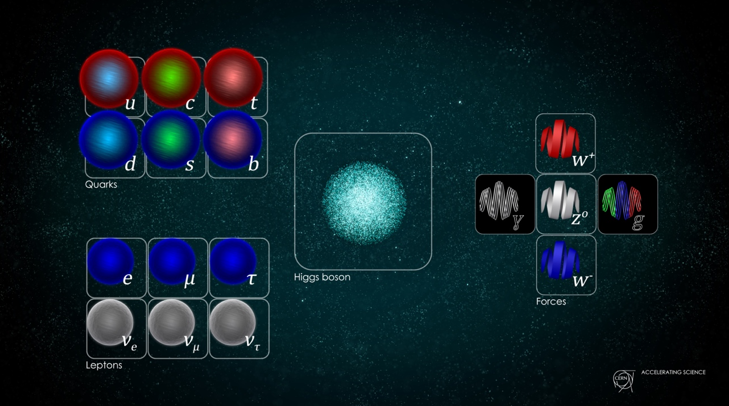
Figure 1: (left) The three families of quarks and leptons present in ordinary matter (the symmetric elementary particles forming antimatter are not shown); (center) the Higgs boson providing mass to the particles, and (right, from left to right) the particles mediating the electromagnetic interaction (photons, denoted as gamma), weak nuclear force (W+, W- and Z0 particles), and strong nuclear force (gluons, denoted as g).
2. Modern Cosmology
As progress was made in the (quantum) study of the microcosm at the beginning of the 20th century, so was progress in the (classical) study of the macrocosm. People learned to distinguish between nebulae and galaxies. People learned to measure the distances to these distant galaxies. It was discovered that the Universe, in which galaxies are like milestones in space, is expanding. Astronomical observations eventually showed that the Universe on a large scale is a large, homogeneous "soup" of galaxies grouped into clusters and filaments, forming a kind of cosmic web. Far from remaining invariable over time, this cosmic web is expanding so that the light reaching us from distant galaxies is shifted toward the red, with a "redshift" that is greater the further away they are from us. Something similar to a Doppler effect. As had happened with the microcosm, advances in the study of the macrocosm also gave rise to a new branch of physics: cosmology. The expansion of the Universe indicated that, going far enough back in time, there would come a time when matter would be at such a high density that galaxies would no longer have enough space between them. Going even further back, not even atoms would have enough space between them. The Universe could only contain a "concentration" of subatomic particles. Therefore, if we wanted to study the earliest moments of the Universe, we would have to use quantum physics. And, going even further back, there would come a time when neither quarks nor leptons would have any room. What's more, there would come a time when the energy density of the Universe would be so high that even gravity would behave quantumly, meaning that time and space would cease to be continuous and would be quantized. As we said before, these are the limits of current quantum physics, so we cannot go back any further, if, at this point, it still makes sense to "go back in time."
Let's take, then, as a starting point, the instant, called the Big Bang, when space and time first took on their current meaning, and reconstruct the evolution of the Universe over time. As we said, at that instant, material particles could not exist. So, how did these particles appear? How did the nuclei of the different elements that fill the Universe today form? How did its structure emerge, that is, how did stars and galaxies form? And the planets? And life? To understand all this, let's assume that the laws of physics we know today and here have always been valid everywhere. If not, we couldn't do cosmology. (This assumption is consistent with the Copernican hypothesis that our instant and position in the Universe are not special.)
Various observational facts, such as the absence of curvature of space, its great homogeneity on large scales, or the shape of the spectrum of spatial fluctuations (see below), strongly suggest that the initial expansion of the Universe before the appearance of matter must have been extremely rapid and accelerated, which is why that period is called inflation or inflationary period. Even in the absence of material particles, the interactions had to be, as we said, the same as today, at least in our realization of the Universe, if there is more than one. The only special thing about the Universe at that instant is that it was empty and, therefore, the quantum system that described it was in a state of minimum energy (the ground state of these interactions). Normally (that is, in the laboratory), when a system is in its ground state, there is, by virtue of the Heisenberg Uncertainty Principle, a tiny probability that the system will randomly depart from that state and a small number of particles and antiparticles will appear locally. (The conservation of certain physical quantities, such as the oppositely signed baryon and lepton numbers, in any interaction, guarantees that both types of particles always appear or disappear at the same time.) When this happens, they quickly encounter each other and annihilate, so that the system returns almost instantly to the ground state. However, in the early inflationary Universe, these quantum fluctuations caused the stable emergence of matter. Indeed, when a small number of particles and antiparticles appeared somewhere, the rapid expansion of the Universe caused them to very rapidly separate from each other, so that they could no longer encounter and annihilate. Thus, particles were constantly being created. This, in turn, caused the accelerating expansion of the Universe to gradually slow down, as the kinetic energy of the Universe's expansion was converted into the mass of particles and antiparticles (following the famous law E=mc2), until the expansion ceased to accelerate and continued at a more leisurely pace, unable to create more matter. Then, the expansion even became slower, as the kinetic energy of the Universe was converted into the potential energy of the matter it contained.
3. Emergence of the Early Universe
The first matter must have appeared, evidently, in its simplest form: quarks and leptons, which interacted with each other through particles carrying the different forces. Gluons tended to group the quarks together, but photons, extremely energetic at that time due to the temperature of that Universe, prevented this. However, as the expansion of the Universe continued and, therefore, its cooling, the strong nuclear force soon and permanently confined all the quarks in pairs and triplets, without the now less energetic photons being able to break the confinements. Thus, a tiny fraction (on the order of 10-20) of a second after the Big Bang, the subatomic particles we know today appeared for the first time, along with a cloud of free leptons. In this plasma, all kinds of interactions between particles obviously occurred, including particle-antiparticle annihilations and their inverse process, the creation of pairs from sufficiently energetic photons. (For a photon to give rise to a pair, its energy E must exceed the mass 2m of the particle pair—where m is the mass of each particle—multiplied by the speed of light, c, squared.) The Universe continued to expand and cool, which would progressively give rise to new types of organization of matter.
On the one hand, photons gradually ceased to be sufficiently energetic to create massive particle-antiparticle pairs. As their annihilation continued to be possible, particles and antiparticles gradually disappeared, starting with the most massive, until only the least massive baryons, protons and neutrons and their respective antiparticles (antiprotons and antineutrons of equal mass), and the least massive leptons (electrons, positrons, neutrinos, and antineutrinos) remained. This process is estimated to have taken place within a period of 10-6 s to 1 second after the Big Bang. Thus, during this progressive cooling, protons annihilated with antiprotons, and neutrons with antineutrons. Fortunately, for some reason that is still being studied, there weren't equal numbers of both (baryonic asymmetry), so a very small number of protons and neutrons remained in the Universe (one in every initial billion), with identical abundances of both. Thanks to this residual abundance of baryons, not only stars and galaxies exist today, but also life.
Around that second after the Big Bang, the time of the annihilation of electrons and positrons arrived, although again—and for equally unknown reasons—a residual abundance of electrons also remained in the same proportion as protons, so the Universe has no net electrical charge. But before that, neutrinos, characterized by their limited interaction with the rest of matter, stopped colliding with protons and neutrons. Therefore, neutrons began to disappear rapidly (through the beta decay mentioned earlier), giving rise to more protons, without the previous interactions involving electrons, positrons, neutrinos, and antineutrinos being able to refill the half-empty pool of neutrons. If nothing had prevented this, only protons would exist today, so there would be only hydrogen in the Universe.
Fortunately, at that moment, after the first second, the temperature of the Universe had already dropped below 109 K (K stands for degrees Kelvin), enough for nuclei to become stable. Up until that point, photons were energetic enough to break them apart (through photodisintegration). But as the different isotopes began to become stable, the few neutrons that remained were able to take refuge inside the nuclei thanks to the strong nuclear force that kept them bound to the protons. Furthermore, the low density of the Universe at that time only allowed for binary collisions, so only isotopes with the fewest neutrons, corresponding to the lightest chemical elements in the periodic table (hydrogen, helium, lithium, beryllium, and boron), could form. The majority of the protons (90%) remained unpaired, that is, in the form of hydrogen nuclei, and the vast majority of the rest paired up as helium nuclei. This primordial nucleosynthesis, which occurred when the Universe was between one and three minutes old, explains the abundance of all these isotopes in the Universe today.
The resulting plasma, now composed of free nuclei and electrons, continued to cool. At these temperatures, atoms, that is, the bound states of nuclei and electrons, were not yet possible because photons were energetic enough to break the bond immediately (through photoionization). However, around 380,000 years after the Big Bang, the temperature dropped below the ionization temperature of hydrogen, the most abundant element so that photons could no longer ionize these atoms. Consequently, the electrons and protons joined together to form hydrogen atoms, and the charged particles disappeared in the Universe, allowing photons, carriers of the electromagnetic interaction between charged bodies, to travel freely through space in all directions, like when fog lifts and we can see great distances. At that time, the temperature of the Universe, the temperature corresponding to the photons that began their long journey to us, was about 3000 K.
Indeed, those photons have since traveled freely through space until they reached us from all directions with the same intensity in the form of cosmic microwave background radiation, corresponding to a temperature of 2.73 K. This indicates a factor of expansion of the Universe of approximately 1100 during that period, which we estimate at 13.8 billion years, very close to the age of the Universe. This "gas" or "soup" of photons cooled due to the expansion of the Universe, just as the gas of neutral atoms that appeared at the same instant that the radiation decoupled from matter did (Initially, the gas of atoms cools more rapidly than the gas of photons, but the various interactions that, as we will see, matter has subsequently undergone have reheated and even locally re-ionized it.).
The temperature of 2.73 K is only the average value. The temperature of the cosmic background radiation shows tiny fluctuations (on the order of one hundred-thousandth) in different directions depending on the angle covered. These fluctuations tell us that the density of the Universe at the moment of radiation decoupling was not strictly uniform. The density fluctuations caused photons to oscillate within the potential wells associated with matter: they fell toward their centers, attracted by gravity until, near those centers where gravity was already weaker, the photons' tendency to scatter again overcame gravity, and they moved back again.
Due to the Doppler effect (normal and gravitational, an effect of Einstein's general relativity), this back-and-forth of the photons produced oscillations in their wavelengths that became decoupled and, consequently, left their mark on the temperature of the background radiation we see today and are manifested in its spectrum. Because of their similarity to the oscillations of a gas that produce sound, these oscillations are called "acoustic," even though they refer to the temperature of the background radiation and not to a sound. In fact, just as the properties of a musical instrument are reflected in the spectrum of the sound it produces—that is, in the distribution of intensities at different frequencies—the angular spectrum of the temperature of the background radiation, that is, the distribution of intensities at different angular frequencies (the inverse of the corresponding wavelengths), informs us, like a barcode, about the properties of the Universe.
An important piece of information that the study of this spectrum has provided us with is that the Universe contains approximately six times more matter than ordinary matter known from the light it emits, and that, because it does not interact with light (except gravitationally), it had gone unnoticed. We only suspected its existence due to its gravitational effects on ordinary matter (as shown by the rotation of galaxies) or on light rays (producing gravitational lenses very useful in astronomy). Precisely because it does not interact with ordinary baryonic matter and radiation, this new matter took the name "dark matter." Dark matter, whose particles or components we have not yet been able to isolate and whose "dark" nature perfectly explains our limited knowledge of its nature, necessarily had to appear alongside ordinary matter and through the same mechanism during primordial inflation. It had to stop interacting with ordinary matter—if it ever did, in any way other than gravitational—before primordial nucleosynthesis, since otherwise, the abundances of the light elements formed would not match the abundances observed in the Universe.
The small-scale fluctuations in the density of the Universe at the instant of radiation decoupling are not unexpected, since dark and baryonic matter (along with radiation) must have been generated by quantum fluctuations at different times depending on places when the Universe was expanding. These tiny, almost imperceptible initial fluctuations in the density of matter and radiation grew until, when the Universe was 380,000 years old, they caused the small fluctuations in the temperature of the background radiation we observe today.
Indeed, the density fluctuations present in the Universe since the appearance of matter and radiation were accentuated by the effect of gravity. But, in the case of ordinary matter and radiation, which remained electromagnetically coupled, this only occurred on scales larger than those through which light could travel (this scale defines the so-called cosmological horizon, which obviously grows over time) because the fluctuations in radiation density merely propagated as (radiative) pressure waves without growing, and the baryons were coupled to them.
However, dark matter fluctuations had been able to grow even on scales smaller than the cosmological horizon since such matter had stopped interacting with ordinary matter and radiation. (In fact, it must have been precisely the potential wells due to dark matter fluctuations, already quite developed within the horizon and decoupled from radiation, that caused the back-and-forth movement of photons and ordinary matter under the effect of gravity.) These dark matter fluctuations grew so much that their own gravity slowed their expansion, so that they began to collapse in on themselves, giving rise to relaxed (i.e., stable) spheres of dark matter, called halos. The first dark matter halos to form must have been the smallest and most abundant, since their initial density fluctuations were the largest in amplitude. But, little by little, it must have been the turn of increasingly massive halos, from the merging of the smallest ones, in a process that has continued to the present.
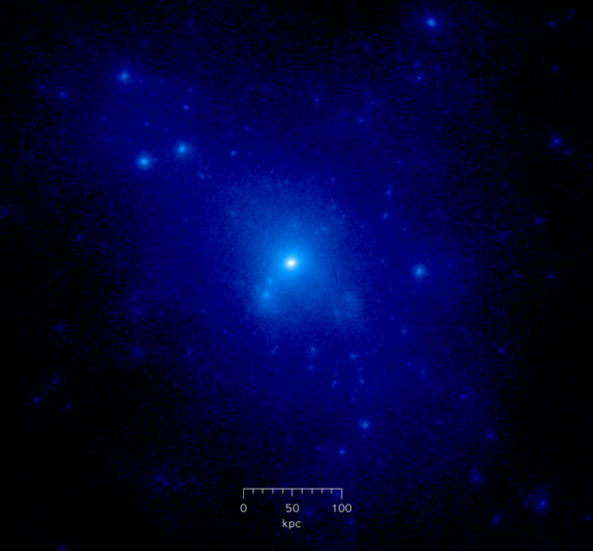
Figure 2: Image obtained from a cosmological numerical simulation of a large dark matter halo merging with a few smaller ones. Halos harbor one central main galaxy and a few satellites (bright spots) -which also gradually merge- and intergalactic gas (diffuse light). Even though dark matter is invisible, it causes the bulk of the gravitational potential of the structures shown in the image.
Meanwhile, the baryonic matter fluctuations within the horizon had continued to oscillate alongside the radiation with a fixed amplitude and increasing wavelength as the universe expanded. After the radiation decoupling, baryonic matter began to move freely. However, just at that moment, photons began to travel great distances within the horizon and, as they dispersed homogeneously throughout space, erased all baryon fluctuations before completely decoupling from them. Therefore, the baryon fluctuations not only did not grow freely as the dark matter fluctuations did, but they disappeared altogether.
Thus, the baryon gas uncoupled from the radiation could only respond to the gravity of the dark matter halos, which ultimately slowed their expansion and caused them to fall toward them, unlike the photon gas (hotter than the gas of atoms), which continued to move away from them unfazed. This change in the motion of the baryons also left an observable imprint on their density fluctuation spectrum, similar to what the back-and-forth of photons had previously left on the temperature fluctuation spectrum of the background radiation. This signal, by analogy to the acoustic oscillations of the background radiation, is called a "baryon acoustic oscillation." However, in this case, it is not more an oscillation but rather a disturbance in the expansion of baryonic matter due to the slowdown around the dark matter halos.
Thus, from that moment on, the baryons gradually fell into the dark matter halos. This process began in the more massive halos, with greater gravity, but also less abundant, and, as the baryon gas that continued to expand around the less massive and more abundant halos cooled, it also began to do so after a time within them. Indeed, the baryon gas trapped within the halos, which had been overheated by their fall, also eventually cooled within them and fell to their centers, contracting there until it reached densities and temperatures capable of initiating thermonuclear reactions within them, thus giving rise to the first luminous objects in the Universe. This process was not easy, and the "dark ages" of the Universe—that is, the era without luminous objects—lasted about at least two hundred million years. The reason is that cooling the gas within the halos was not easy because the gas was no longer expanding and was also made up of neutral atoms, so its particles did not interact electromagnetically and did not emit photons capable of dispersing their energy. The only way it could cool was through the emission of very low-energy photons produced by the rotation of a small abundance of hydrogen molecules (H2) produced in catalytic reactions from neutral hydrogen atoms.
4. Emergence of the Universe's Large Structures
This is how the first stars, called Population III stars, appeared from the primordial neutral material of the Universe. Evidently, as soon as these stars appeared within a halo, they photo-dissociated the H2 molecules, automatically preventing the formation of new stars within the halo. For this reason, Population III stars must have formed in isolation or, at most, in small groups. Because they were composed almost entirely of hydrogen, Population III stars were probably much more massive (up to 1,000 solar masses) and ionizing (the photons they emitted were of very high energy) than today's stars. But most importantly, like all stars, they supported their weight through thermonuclear reactions that transformed the initial hydrogen into heavier elements (helium, carbon, oxygen, etc.).
In fact, their great mass meant they consumed their nuclear fuel at a high rate, resulting in very short lifetimes. After exhausting their fuel, they would eventually explode in the form of supernovae, scattering the heavy elements they had formed (called metals by astrophysicists) around them and, in some cases, collapsing their cores into black holes. And when the star was over 260 solar masses, it would collapse entirely into a black hole. Thus, these stars, which formed in neutral and pristine regions (without metals), would ionize large bubbles around themselves, showering them with metals and seeding them with massive black holes.
The most massive halos that would develop inside these ionized bubbles would trap large amounts of ionized gas, which would be cooled very efficiently this time by photons produced in the interactions between their charged particles (essentially between electrons, which are much more abundant and less massive than nuclei). In this way, large clouds of ionized, metal-enriched gas would crowd toward the center of these massive halos, where they fragmented and concentrated, giving rise to millions of Population II stars, more similar to today's Population I stars and with much longer lifetimes (up to billions of years) than Population III stars. This is how the first galaxies formed, less ionizing than Population III stars but much more luminous, which continued to form in neutral zones free of metal pollution. This explains why today, with the James Webb Space Telescope (JWST), we observe large galaxies until the dawn of the Universe (when it was only about half a billion years old at redshifts of almost 15), but we have not yet been able to detect Population III stars. Furthermore, as the Universe became ionized and polluted with metals, it became more difficult for new Population III stars to form. In fact, the gas filling the Universe became fully ionized when it was approximately half its current age, 13.8 billion years. We believe that no Population III stars have formed since then.
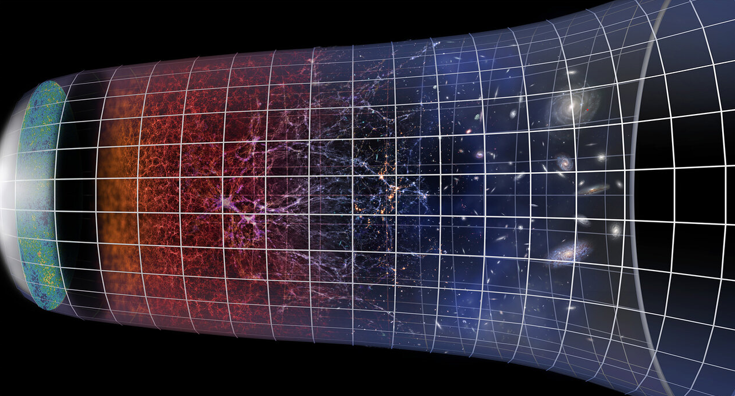
Figure 3: Emergence of the structures of the Universe from the Big Bang (left edge) to the present day, where the well-formed structures of galaxies are evident in the image (right edge). The anisotropies of the cosmic microwave background radiation, which occurred when the age of the Universe was 380,000 years, are shown near the Big Bang in greenish hue, followed by a black area corresponding to the period before the formation of the first galaxies, starting 100 to 200 million years after the Big Bang, the Cosmic Dawn.
As halos merge with other halos, the galaxies they contain become trapped within the new, larger, and more massive halos. As they orbit within them, they experience dynamical friction with dark matter, which causes their orbits to decay. The greater the mass of the galaxy, the greater the dynamical friction it experiences, so the most massive galaxies quickly find their way to the center of the halo, where they gradually merge with each other. Only dwarf galaxies continue orbiting the massive central galaxy until the halo undergoes another merger. In addition to this merger process, galaxies gradually add gas, which continues to cool within the halo. This cooling was more efficient in the past due to the high concentration of low-mass halos, as were mergers between galaxies because the haloes were smaller. This caused galaxies to develop very rapidly at first, and their evolution has calmed down over time, so that today we can observe the presence of quite massive galaxies when the Universe was only about 0.5-1 billion years old.
Galaxies have not only grown in abundance of stars (and interstellar gas) but also in another spectacular structure they contain. Indeed, the first galaxies formed from the material present in ionized bubbles also trapped another remnant of Population III stars: black holes of hundreds of solar masses. Black holes also experience dynamic friction within their host galaxies so that they also end up at their centers, where they also merge with each other. What's more, when a burst of star formation occurs as a result of a galactic merger or the accretion of gas by the galaxy, its central black hole also receives some of the spoils, that is, the newly available interstellar gas and the newly formed stars. Conversely, the intense radiation emitted by a black hole as it feeds (this radiation is produced in the accretion disk that surrounds it) heats and expels the remaining gas in the galaxy, thus halting star formation. All this causes central black holes to grow over time, as galaxies (and halos) do, until they become supermassive, reaching masses of billions of solar masses. In fact, the mass of supermassive black holes and the mass of the galaxies that contain them grow in step. Their mass ratios remain balanced at the level of five thousandths.
These enormous black holes, usually rotating, generate enormous relativistic jets collimated by magnetic fields that transport energy from the active nucleus of the galaxy to vast cosmic distances in the intergalactic medium. They manifest as quasars for long periods in the Universe until the latter is about 4 billion years old. After that age, there are fewer quasars, but black hole activity continues, modifying their galactic and intergalactic environment. Also, supernova explosions occur very frequently in every galaxy. These explosions modify the galactic medium and increase the metallicity of galactic clouds, which, when they condense, will once again give rise to the birth of stars. Star birth generally entails the birth of a stellar system comparable to the solar system. The nearly 10,000 exoplanets currently detected in our galactic environment alone are good proof of this. In the molecular clouds studied in our galaxy, and recently in some nearby galaxies, there is evidence of hundreds of molecular lines due to different molecular transitions. Molecular lines are also found in the atmospheres of exoplanets. To date, none of these spectral lines are evidence of a prebiotic molecule. However, there is no reason to think that the life that has arisen (emerged) on planet Earth is unique in the Universe. With 1022 stars in a 13.8 billion years old Universe, it is likely that something resembling terrestrial life has flourished somewhere, sometime.
Further Reading
(In increasing level of difficulty)
Últimas noticias del Universo, Jon Marcaide, Espasa, 2021 (popular reading)
The First Three Minutes: A Modern View of the Origin of the Universe, S. Weinberg (Nobel Laureate), Basic Books, 1977 (2nd edition 1993) (popular reading)
Wrinkles in Time: Witness to the Birth of the Universe, G. Smoot (Noble Laureate) & K. Davidson, Harper Perennial, 2007 (popular reading)
Modern Astrophysics (An Introduction to), B. W. Carroll & D.A. Ostlie, Addison Wesley Publishing Co., 1996
Cosmology (The Science of the Universe), Edward Harrison, Cambridge University Press, 2000
Gravitation and Cosmology (Principles and applications of the General Theory of Relativity), Steven Weinberg, John Wiley and Sons Inc., 1972
The Early Universe (Facts and Fiction), G. Börner, Springer Verlag, 1988
Cosmology (Physical Foundations of), V. Mukhanov, Cambridge University Press, 2005
PARTAGER
